
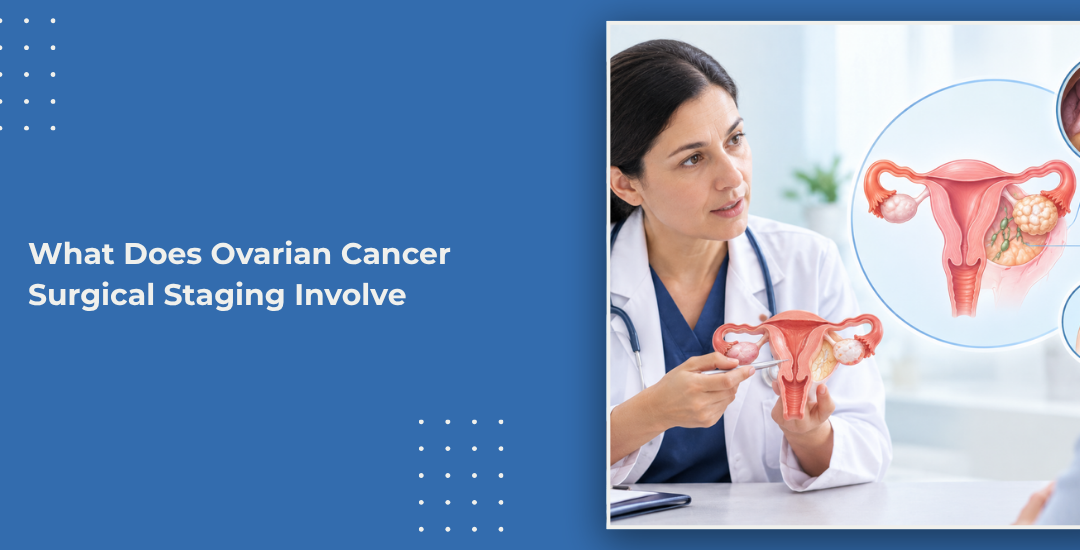
Ovarian cancer surgical staging is how doctors find out how far the disease has spread. It’s done through a careful look inside the abdomen and pelvis, not just scans. A gynecologic cancer surgeon carries this out, since accuracy here shapes everything after. Staging means biopsies, lymph node sampling, and checking the peritoneal surfaces, not just removing the tumour.
According to Dr. Anjali Singh, Surgical Oncologist in Bhubaneswar, “Staging surgery isn’t a formality, it changes the entire treatment plan. Where we take samples from, how thorough the exploration is, Getting it right the first time matters, because an incomplete staging surgery sometimes means going back in later.”
Recently diagnosed with ovarian cancer and unsure what staging surgery involves?
What Happens During Ovarian Cancer Surgical Staging?
Staging surgery covers a lot more ground than people expect. It’s not just about the ovaries.
Abdominal exploration:
The surgeon goes through the entire abdominal cavity, checking every surface, not just where the tumour sits.
Tissue biopsies:
Samples come from the peritoneum, the diaphragm, anywhere that looks suspicious. Each one gets checked under a microscope
Lymph node sampling:
Nodes near the pelvis and around the aorta come out too, since finding cancer there changes the stage entirely.
Omentectomy:
That layer of fatty tissue over the abdominal organs often gets removed as well. It’s a spot where ovarian cancer likes to spread early
This level of detail is why staging surgery takes real training, not just surgical experience in general. A gynecologic cancer surgeon brings that specific focus to every step of the procedure.
Why Does Surgical Staging Matter For Ovarian Cancer Treatment?
Staging isn’t a formality tacked onto surgery, it’s what the rest of treatment gets built around.
Treatment planning:
Whatever the surgery finds decides what comes next, chemotherapy or not, and for how long.
Accuracy over imaging:
Scans miss things. Microscopic spread often only shows up once biopsies are examined, and that’s the whole reason surgical staging stays the gold standard.
Prognosis:
Where things stand at diagnosis says a lot about how things go long term, more than most other factors.
Second surgery avoidance:
Do it thoroughly the first time, and there’s less chance of having to go back in later
Ovarian cancer doesn’t always stay put once it leaves the ovaries. That’s part of why CRS with HIPEC for peritoneal cancer comes up so often once disease has spread further into the abdomen.
Why Choose Dr. Anjali Singh For Ovarian Cancer Surgical Staging?
Dr. Anjali Singh trained in Surgical Oncology at JIPMER and holds fellowship training in Peritoneal Surface Malignancy. She’s also published research on ovarian cancer surgery, including work on total parietal peritonectomy in advanced disease. For her, staging isn’t a box to check before the real work begins, it’s the foundation everything else gets built on.
Cases go through a multidisciplinary tumour board, so what surgery finds turns into a clear plan without unnecessary delay. Call +91 8056885498 to book your consultation.
Call +91 8056885498 to book your consultation.
Frequently Asked Questions
How long does ovarian cancer surgical staging take?
Usually 3 to 5 hours, sometimes longer depending on how much needs exploring.
Is staging surgery the same as tumour removal?
Not necessarily, sometimes it happens alongside the main surgery, sometimes separately .
Does staging affect chemotherapy decisions?
It does, whatever surgery finds is what shapes the treatment plan.
Can staging be done with minimally invasive surgery?
Sometimes, though more advanced cases may call for open surgery instead.
Reference
National Cancer Institute, Ovarian Epithelial, Fallopian Tube, and Primary Peritoneal Cancer Treatment PDQ Patient Version: https://www.cancer.gov/types/ovarian/patient/ovarian-epithelial-treatment-pdq
NCBI Bookshelf, Ovarian Epithelial, Fallopian Tube, and Primary Peritoneal Cancer Treatment PDQ, Health Professional Version: https://www.ncbi.nlm.nih.gov/books/NBK66007/
Disclaimer:This blog is for general information and not medical advice. Consult a gynecologic cancer surgeon for a diagnosis-specific evaluation.