
Yes, esophageal cancer can spread to the liver. It doesn’t happen to everyone diagnosed with the disease, but in more advanced cases, the liver is one of the more common places it turns up. Early on, esophageal cancer tends to stay put, confined to the wall of the food pipe. Over time, though, cells can break away and travel through the bloodstream or lymphatic system to reach other organs, and the liver ends up being a frequent stop — partly because of how blood drains from the digestive tract. Doctors call this metastasis, and once it happens, the whole treatment conversation shifts.
According to Dr. Anjali Singh, Surgical Oncologist in Bhubaneswar, “Once esophageal cancer reaches an organ like the liver, the goal shifts from removing a single tumor to controlling disease throughout the body, and that changes almost every decision we make from that point on.”
What Signs May Indicate That Esophageal Cancer Has Spread to the Liver?
Liver involvement doesn’t always make itself known early. When there are signs, they tend to be vague, the kind of thing that could mean any number of things. Weight loss that doesn’t match how much someone’s eating. Appetite that’s dropped off. A tiredness that feels heavier than the usual treatment fatigue. Some patients notice abdominal discomfort or a fullness that wasn’t there before, sometimes with nausea alongside it. Jaundice — that yellow tint in the skin or eyes, caused by a buildup of bilirubin is a bit more telling, though even that isn’t exclusive to cancer spread.
Unexplained weight loss
Losing weight without a change in diet or activity, usually gradual rather than sudden.
Persistent fatigue
A tiredness that doesn’t ease with rest and feels different from usual treatment fatigue.
Abdominal discomfort or swelling
A sense of fullness, bloating, or mild pain, often noticed in the upper right abdomen.
Jaundice (yellowing of skin or eyes)
Happens when the liver can’t clear bilirubin normally, giving skin or eyes a yellow tint.
Nausea
A general queasiness that can occur with or without vomiting.
Reduced appetite
A noticeable drop in hunger that doesn’t return to normal after a few days.
Still, none of this adds up to a diagnosis on its own. Chemotherapy causes fatigue. Radiation causes nausea. The original tumor can cause discomfort. So can something entirely unrelated. That overlap is exactly why any of these symptoms, if new or persistent, deserve a proper look rather than a guess in either direction.
How Is Liver Metastasis From Esophageal Cancer Diagnosed?
Working out whether the liver is involved usually starts with the basics how the original tumor was staged, what treatment has already happened, what a physical exam turns up. Liver function blood tests often come first, since abnormal numbers can raise a flag before any symptom does. From there, imaging takes over, and doctors tend to use similar tools across other GI cancers too, including gastric cancer, when it’s relevant.
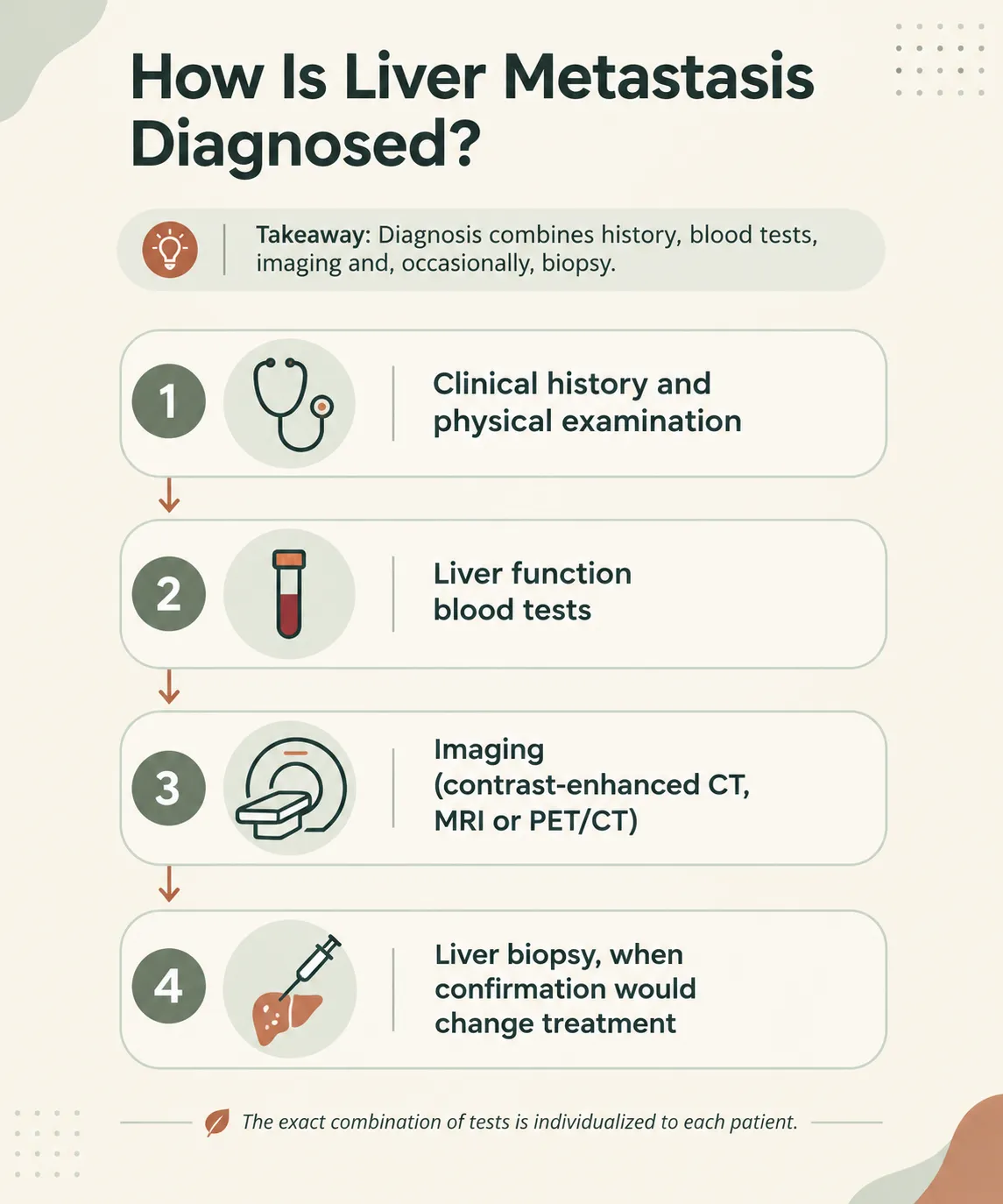
Contrast-enhanced CT is usually the first choice for spotting masses in the liver. MRI comes in when something’s unclear, or when there’s a reason to avoid more radiation. PET/CT gets added sometimes, mainly to check whether things have spread further than the liver alone. A biopsy isn’t always necessary it’s really only called for when the imaging is ambiguous, or when knowing for certain would actually change what happens next.
Can Liver Metastases From Esophageal Cancer Be Treated?
What comes next depends on several things at once: how much of the liver is affected, whether other organs are involved, the type and stage of the original cancer, how the patient’s doing overall, and what’s already been tried. Chemotherapy is usually where treatment starts, since it works throughout the body rather than at one spot. Immunotherapy or targeted therapy sometimes enter the picture too, depending on what the tumor’s biomarkers show.
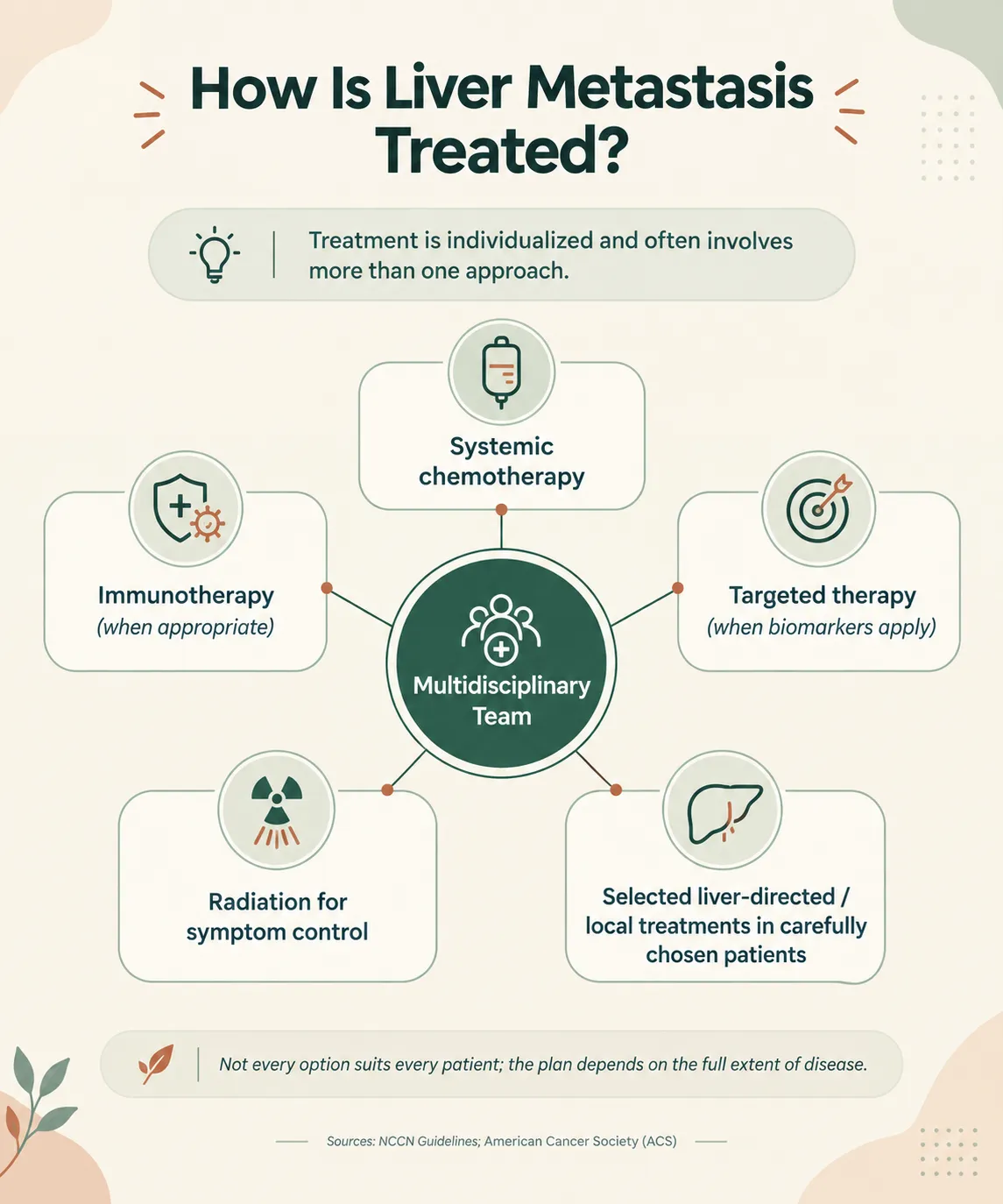
Radiation can help take the edge off symptoms in a specific area. And for a smaller group of patients — where liver disease is limited and everything else is under control — something like HIPEC might come up in conversation, though it’s far from a routine option. These decisions rarely rest on one doctor’s opinion alone. They usually go through a team medical oncology, surgical oncology, radiology — all weighing in before a plan is set.
When Should You Consult a Doctor About Possible Liver Metastasis?
If something changes, patients already in treatment don’t have to wait for their next scheduled visit. A few things are worth calling about sooner rather than later: skin or eyes turning yellow, abdominal swelling or pain that keeps climbing, vomiting that won’t settle, weight dropping in a way that’s hard to explain, or sudden confusion and weakness.
None of that automatically means the worst. Plenty of these symptoms trace back to treatment itself, or to something else altogether. The point of calling early isn’t to panic — it’s to get answers faster, so the care team can act on real information instead of guesswork.
Frequently Asked Questions
Can esophageal cancer spread to the liver?
Yes, in some cases — usually with more advanced disease. It’s not something every patient diagnosed with esophageal cancer will experience.
What are early signs of liver involvement in esophageal cancer?
Often there aren’t any, at least at first. When signs do show up, they tend to be fatigue, reduced appetite, mild abdominal discomfort, or weight loss that’s hard to explain.
How do doctors check if esophageal cancer has spread to the liver?
Usually with a combination liver function blood tests plus imaging like contrast-enhanced CT, MRI or PET/CT. A liver biopsy comes in only if confirmation is genuinely needed.
Is liver metastasis from esophageal cancer treatable?
Yes, though the aim is generally to control the disease and manage symptoms, not promise a cure. Options include chemotherapy, immunotherapy, targeted therapy, and in select cases, local liver-directed treatment.
Does liver metastasis mean a fixed prognosis?
No. It varies a lot — depending on how far the disease has spread, the tumor’s biology, how it responds to treatment, and the patient’s overall health. Prognosis is always an individual conversation, not a fixed number.
Reference
Journal of Thoracic Disease, Initial Experience with Uniportal VATS for Lung Cancer Treatment: https://pmc.ncbi.nlm.nih.gov/articles/PMC7330296
National Cancer Institute, Non-Small Cell Lung Cancer Treatment PDQ Patient Version: https://www.cancer.gov/types/lung/patient/non-small-cell-lung-treatment-pdq
Disclaimer: This is general information, not medical advice. Consult a surgical oncologist for a diagnosis-specific evaluation.